History
The Sedlec Ossuary: history, Rint and the bones
From the soil of Golgotha to the woodcarver of 1870: how a medieval cemetery became a chapel decorated with human bones.
Book the day trip ↗Quick answer
The Sedlec Ossuary is a small Roman Catholic chapel beneath the Cemetery Church of All Saints, in Sedlec near Kutná Hora. Its cemetery grew after Abbot Henry sprinkled earth from Golgotha over it in 1278, and the Black Death and the Hussite Wars filled it further. The woodcarver František Rint arranged the bones in 1870, for the House of Schwarzenberg, into a chandelier, garlands, mounds and a coat of arms.
Sedlec Abbey
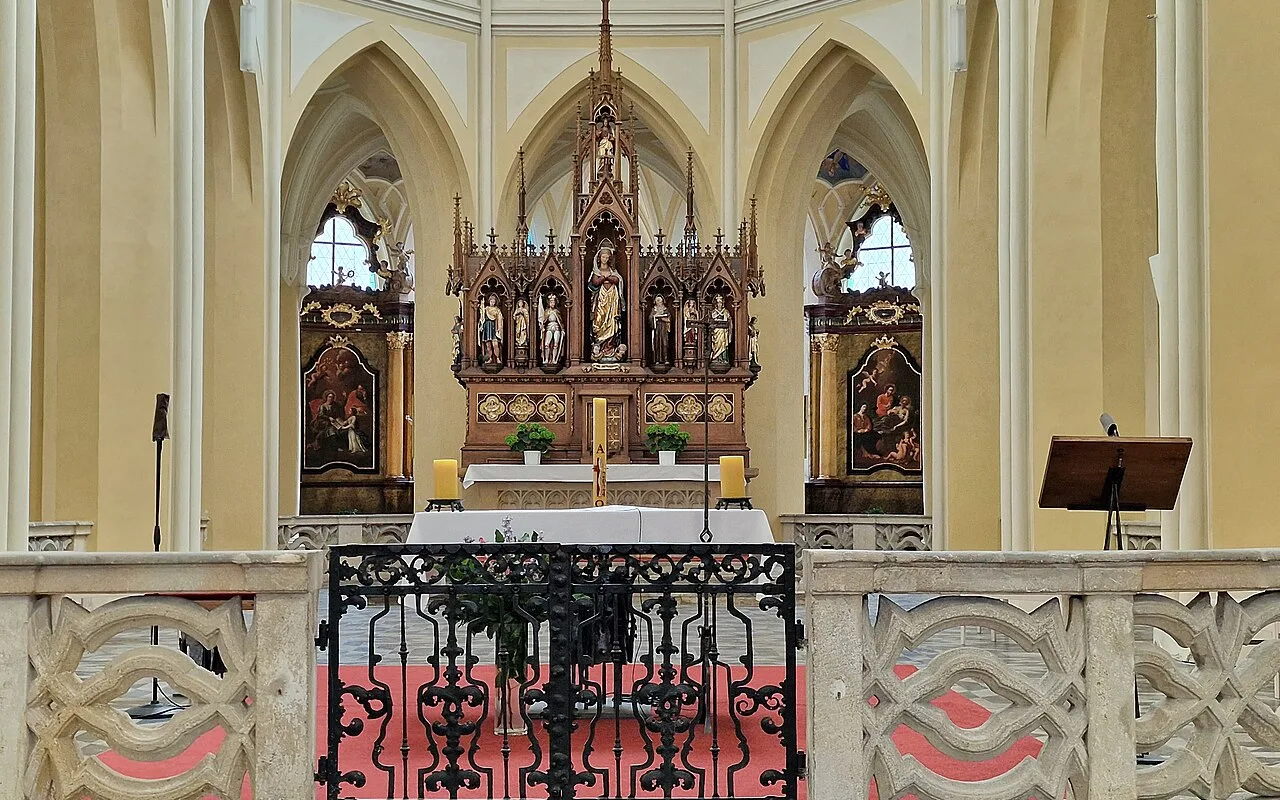
The story starts with the abbey. Sedlec Abbey was founded in 1142 from Waldsassen as the first Cistercian monastery in Bohemia. Hussites led by Jan Žižka burned it in April 1421 and many monks were killed, and the abbey was dissolved in 1783. The ossuary lies in the abbey's former grounds, beneath the Cemetery Church of All Saints.
The earth from Golgotha
In 1278 Abbot Henry was sent to the Holy Land by King Ottokar II of Bohemia. He returned with a small amount of earth taken from Golgotha and sprinkled it over the abbey cemetery. Burial there was sought after across central Europe. Burials during the Black Death in the mid-14th century, and after the Hussite Wars in the early 15th, forced the cemetery to be enlarged greatly.
Remembering the dead
The ossuary is a place of remembrance in the Roman Catholic tradition, and the bones belonged to people whose names are not known to us. That is worth holding in mind as you look at what has been made from them. The decoration speaks of mortality as much as of art.
Why bones end up in an ossuary
An ossuary is a place made to hold the final resting place of human skeletal remains, and it is often used where burial space is scarce. A body is buried in a grave, and after some years its bones are removed and stored. That is how one place can come to hold the remains of tens of thousands. Sedlec's is estimated to hold the skeletons of between 40,000 and 70,000 people.
The church and the chapel
Around 1400 a Gothic church was built in the middle of the cemetery, with a lower chapel for the bones of the mass graves unearthed there. A legend says a half-blind monk was set to stack the bones after 1511. Between 1703 and 1710 a new entrance was built to support a leaning front wall, and the upper chapel was rebuilt in Czech Baroque style to designs by Jan Santini Aichel.
František Rint
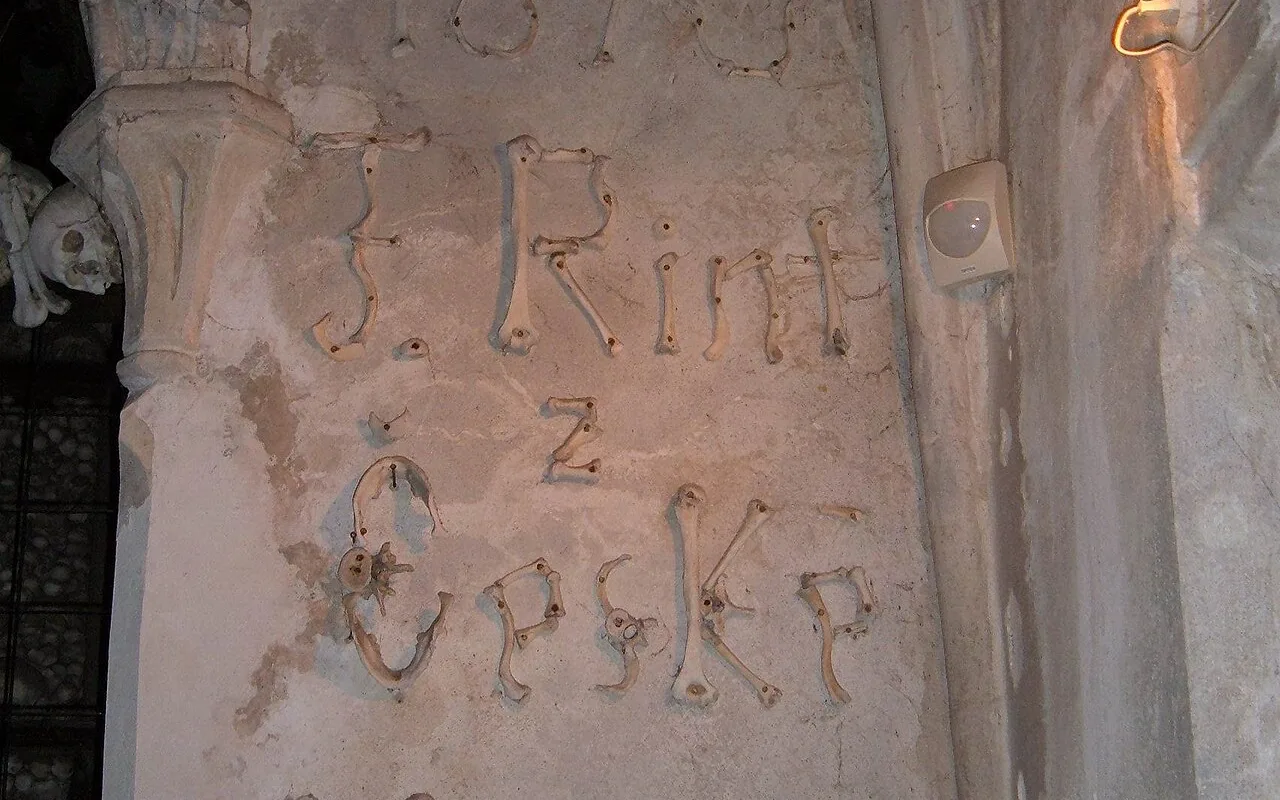
Rint was a woodcarver and carpenter born in 1835 in Česká Skalice in northern Bohemia, and he was employed by the House of Schwarzenberg to arrange the bones in 1870. He left a signature in bone near the entrance, from which we know where he came from. The Schwarzenbergs had been raised to princely status in 1670, and they commissioned the arrangement.
What he made
The chandelier hangs from the centre of the nave and is said to contain at least one of every bone in the human body. Garlands of skulls drape the vault. Four bell-shaped mounds occupy the corners, piers and monstrances flank the altar, and a coat of arms of the House of Schwarzenberg is worked in bone. Rint made all of this while employed by the Schwarzenbergs, a noble family.
Why it matters now
The ossuary is among the most visited sights in the Czech Republic, drawing over 200,000 visitors a year. It sits within a town that UNESCO inscribed in 1995. It is a chapel, and it asks to be visited as one.
Visiting with the history in mind
The nave, the garlands and the chandelier read differently once you know the order of events: the earth from Golgotha, the plagues and the wars, the church around 1400, the Baroque rebuilding by Santini, the commission of 1870. The group tours include a guide who tells this story on site, and the scale of the place, with between 40,000 and 70,000 people estimated, is part of what you see.
Frequently asked questions
How many people are in the ossuary?
It is estimated to hold the skeletons of between 40,000 and 70,000 people.
Who arranged the bones?
The woodcarver František Rint, in 1870, employed by the House of Schwarzenberg.
Is the story of the half-blind monk true?
It is a legend, and it should be read as one.
Is it a church?
It is a Roman Catholic chapel beneath the Cemetery Church of All Saints.
Sources